


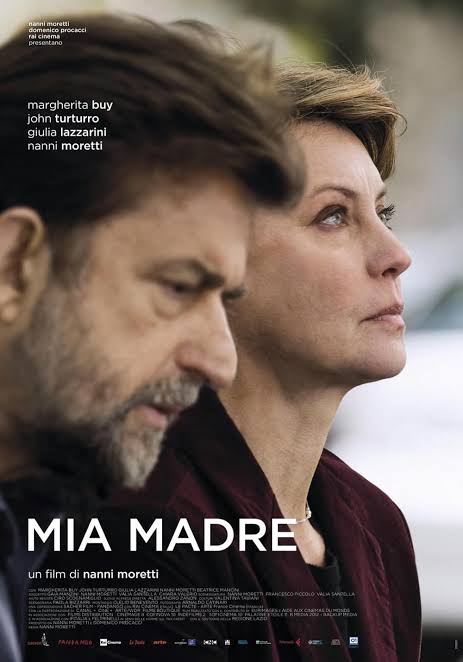
An Insatiable Cinema On Nanni Moretti's Mia madre
Cinema & Medicine
An Insatiable Cinema
On Nanni Moretti's Mia madre
By Luciano De Fiore · Translated by Saeid Shahparnia
Film: Mia madre (My Mother)
Director: Nanni Moretti
Year: 2015
Cast: Margherita Buy, Giulia Lazzarini, John Turturro
In five consecutive films, Nanni Moretti built his alter ego Michele Apicella — a man who, in Sogni d'oro, declared with full conviction: "I don't talk about psychiatry! Not about cardiology, not about radiology. I don't talk about things I don't know!" And yet illness and death have always had a place in Moretti's cinema. Sometimes close and explicit — as in Caro diario (1993), where documentary and autobiographical moments are woven into the fabric of the film. Sometimes through fiction — as in the psychoanalyst of La stanza del figlio (2001), whose work is the daily confrontation with other people's pain, until one day he faces the heaviest loss imaginable: the death of his own child. And sometimes only obliquely — as in the depression and death of Don Giulio's mother in La messa è finita (1985). Mia madre (2015) returns, thirty years later, to that same territory: the loss of a parent.
Ada is a retired teacher of Latin and Greek, still deeply loved and sought out by her former students. The role is played by Giulia Lazzarini. Her two middle-aged children share this difficult experience: Margherita, played brilliantly by Margherita Buy, is a film director caught up in shooting her latest film about labor strikes at a Roman factory; and Giovanni, an engineer, is played by Moretti himself. In taking on this character, Moretti revisits something of the pain he lived through with the death of his mother Agata Apicella in 2010. To write the screenplay alongside Francesco Piccolo and Valia Santella, he reread his daily journals from that period of illness — in his own words, to bring greater truthfulness to the scenes between Margherita and her ailing mother.
But why those scenes, and not his own memories directly? Moretti has displaced the characters — likely out of shame and a sense of inadequacy. That feeling is the film's central material, and the most direct way into it. It is as if Moretti has handed himself over to Margherita Buy: he takes the role of a steady but weary brother who steps away from work to be with his mother. Buy, in turn, plays the director — with all the stubbornness and volatility that usually belong to Moretti himself.
"Give me back reality — get me out of this illusion!"
The factory is a non-place, a cathedral of labor and production gone quiet and hollow. The hospital is cold and timeless, its days following one another without distinction. Yet beneath this surface stillness, the air is thick with death and grief. Giovanni and Margherita each move through it in their own way: Giovanni is steady and calm, giving space to sorrow. Margherita refuses the reality, taking shelter in the film she is making — until her hidden vulnerability finally breaks open, and it is John Turturro, the ebullient American actor, who cries out in her place: "Give me back reality — get me out of this illusion!"
In the end, none of these spaces can offer shelter. Giovanni and Margherita bring Ada home — the only place where every trace of life remains, even in the quiet touch left on the spines of the family library's books.
In Habemus Papam (2010), one character said of another: "He thinks like a man who is satisfied." Moretti in this film is not that man — he is still willing to go into the depths of feeling and pain. A private grief that the language of cinema makes universal, without diminishing its intimacy.
The everyday gestures that take shape over the course of an illness — adjusting the oxygen, peeling an apple, warming soup, helping someone rise — gradually replace ordinary movement. Language shifts too: "let's go," "let's eat," "let's go out" — the plural instead of the singular. Not as performance, but because the boundary between caregiver and the one being cared for slowly dissolves. The film earns its place precisely in the rendering of these quiet moments — the moments when the thread connecting child to parent is beginning to give way.
In an earlier Moretti film, a couple of analysts both wrestled with a shortage of care. In Mia madre, Giovanni and Margherita seem to be repaying years of accumulated emotional debt to their dying mother — each in their own way. And in doing so, guilt yields to presence. The thread of time that had frayed is tied again, and its meaning passes from one generation to the next. A daughter like Margherita can imagine asking her mother one day: "What are you thinking about?" — and hearing, in return, the sweetest possible answer: "Tomorrow."
Luciano De Fiore — Translated by Saeid Shahparnia
In Mia madre, Moretti arrives at his most personal and truthful film — a quiet reckoning with the loss of a mother.